Lab 3: Inverse Kinematics and Trajectory Tracking
Goal
Implement inverse kinematics for a robot leg and create a trajectory tracking system using ROS2.
Please also fill out the lab document .
Part 0: Setup
Clone the lab 3 code repository on your Raspberry Pi:
cd ~/
git clone https://github.com/cs123-stanford/lab_3_2024.git lab_3
Note: Ensure the folder name is
lab_3. If different, update the launch file accordingly.Open the workspace in VSCode.
Examine
lab_3.pyto understand the structure of theInverseKinematicsclass and its methods.Change all the 12 occurances of homing_kp values to 5.5 and homing_kd values to 0.2 in the ~/ros2_ws/src/pupper_v3_description/description/components.xacro file to undo the changes from lab 2.
Part 1: Forward Kinematics (already done in lab 2)
Open
lab_3.pyand locate theforward_kinematicsmethod in theInverseKinematicsclass.
Paste code from lab 2
Review the compositions of the transformation matrices T_0_1, T_1_2, T_2_3, and T_3_ee.
Review the final transformation matrix T_0_ee.
Review the end-effector position (the first 3 elements of the last column of T_0_ee).
Part 2: Implement Inverse Kinematics
Find the
inverse_kinematicsmethod in theInverseKinematicsclass.
TODO 1: Implement the cost function for inverse kinematics.
Use the
forward_kinematicsmethod to get the current end-effector position.Calculate the L1 distance between the current and target end-effector positions.
Return the sum of squared L1 distances as the cost (AKA the squared 2-norm of the error vector).
TODO 2: Implement the gradient function for inverse kinematics.
Calculate the numerical gradient of the cost function with respect to each joint angle using the finite difference method.
Use a small epsilon value (e.g., 1e-3) for the finite difference approximation.
TODO 3: Implement the gradient descent algorithm for inverse kinematics.
Use the provided learning rate and maximum iterations.
Update the joint angles using the calculated gradient.
Stop the iteration if the mean L1 distance is below the tolerance.
Bonus: Implement the (quasi-)Newton’s method for faster convergence.
DELIVERABLE: We use squared L2 norm for our cost function (AKA objective function or loss function). Why is this a useful objective? Why not use L1?
DELIVERABLE: What happens if learning rate is too small… what if learning rate gets too big?
DELIVERABLE: You are using a numerical differentiation approach. However, this loss function is fairly simple and the gradient could be computed analytically (but we use finite differentiation due to simplicity). Think about different loss functions. Where would a numerical gradient come in handy, and where would an analytical gradient be better?
Part 3: Implement Trajectory Generation
Locate the
interpolate_trianglemethod in theInverseKinematicsclass.
TODO 4: Implement the interpolation for the triangular trajectory.
You need to create a function that performs linear interpolation between the triangle’s vertices. The trajectory should loop smoothly from vertex 1 to 2, vertex 2 to 3, and then from vertex 3 back to vertex 1 based on the time variable. The input to the function is a time variable t that dictates where along the triangle’s edges the point currently lies for a given 3 second period. Each vertex transition (e.g., from vertex 1 to vertex 2) should last approximately 1 second. For example 0 <= t < 1 should interpolate between vertex 1 and vertex 2.
Use the provided
ee_triangle_positions, which define the 3 vertices of the triangle trajectory (this is a 3x3 matrix).Implement linear interpolation between the triangle vertices based on the input time
t. Use the np.interp function from NumPy to handle the interpolationEnsure the trajectory loops every ~3 seconds approximately.
DELIVERABLE: This interpolation between the 3 points on a triangle is called the “Raibert Heuristic”, named after the founder of Boston Dynamics. How would you coordinate the movement of 4 legs on a quadruped assuming they each follow the Raibert heuristic? Specifically, which legs should be synchronized (same point of the triangle at the same time)? Feel free to draw a diagram.
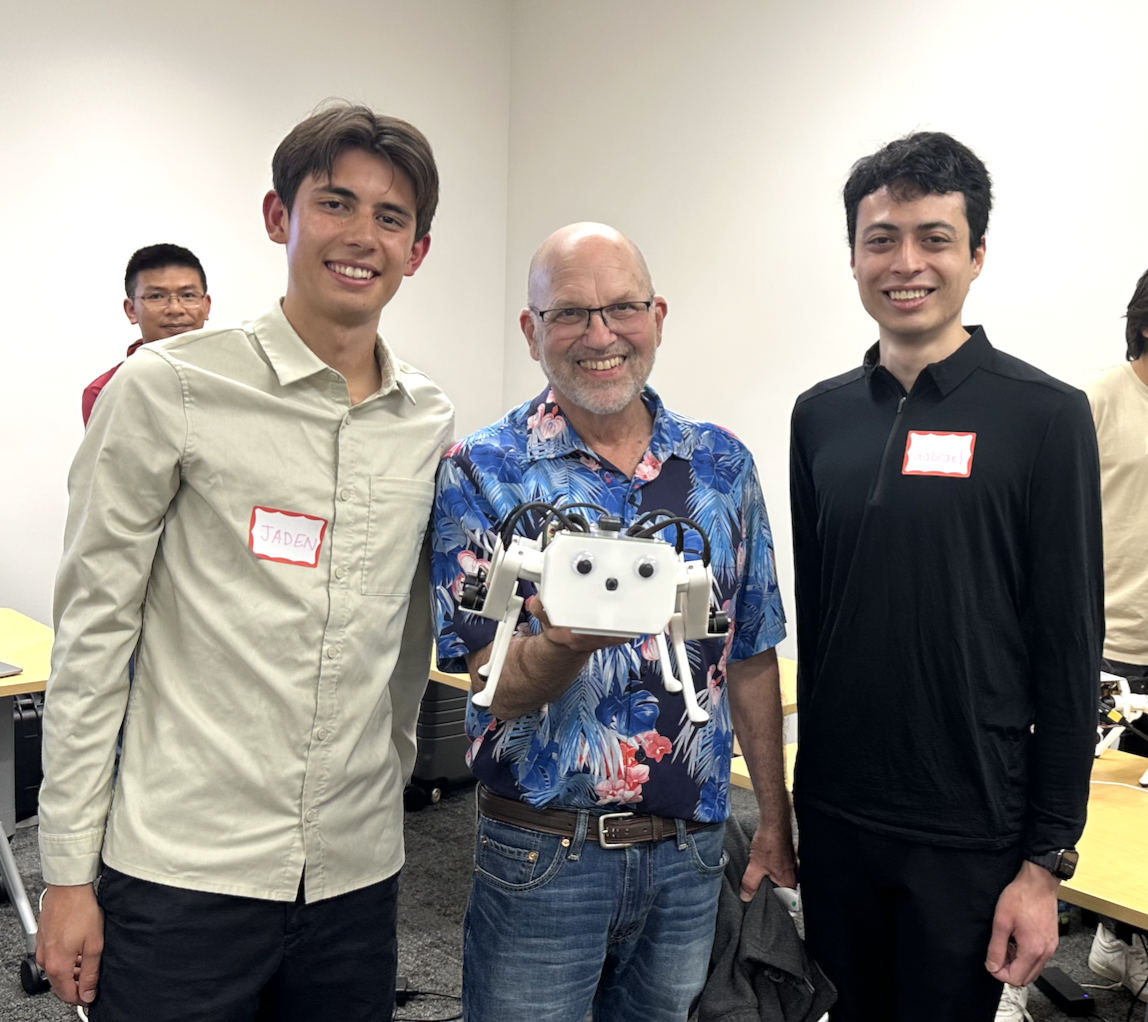
Marc Raibert at the Spring 2023 Pupper demo day.
Part 4: Run and Test Your Implementation
Run the launch file using the following command:
ros2 launch lab_3.launch.py
Observe the robot leg’s movement and the terminal output.
Experiment with different trajectory shapes by modifying the
ee_triangle_positionsin the__init__method.
DELIVERABLE: Take a video of the robot leg tracking the triangular trajectory and submit it with your submission. The triangle motion should be smooth and continuous based on your implementation.
Part 5: Analyze and Improve Performance
Modify the
ik_timer_periodandpd_timer_periodto see how they affect the system’s performance.Try different initial guesses for the inverse kinematics algorithm and observe the convergence behavior.
DELIVERABLE: In your lab document, report on:
How different timer periods affect the system’s behavior
The impact of initial guesses on the inverse kinematics convergence
DELIVERABLE: What will the behavior look like if the IK timer has too low of an update frequency? What will happen if update frequency is too high? DELIVERABLE: What is the behavior of the optimizer when the initial guess if very poor? DELIVERABLE: Say you are running this controller for a Pupper walking trajectory. What will the behavior look like if K_p is too low?
Additional Notes
The
inverse_kinematicsmethod uses gradient descent. Ensure you understand how the cost function and gradient are calculated.The
interpolate_trianglemethod should create a continuous trajectory between the defined triangle points.
Congratulations on completing Lab 3! This hands-on experience with inverse kinematics and trajectory control will be crucial for more advanced robot control tasks in future labs.